
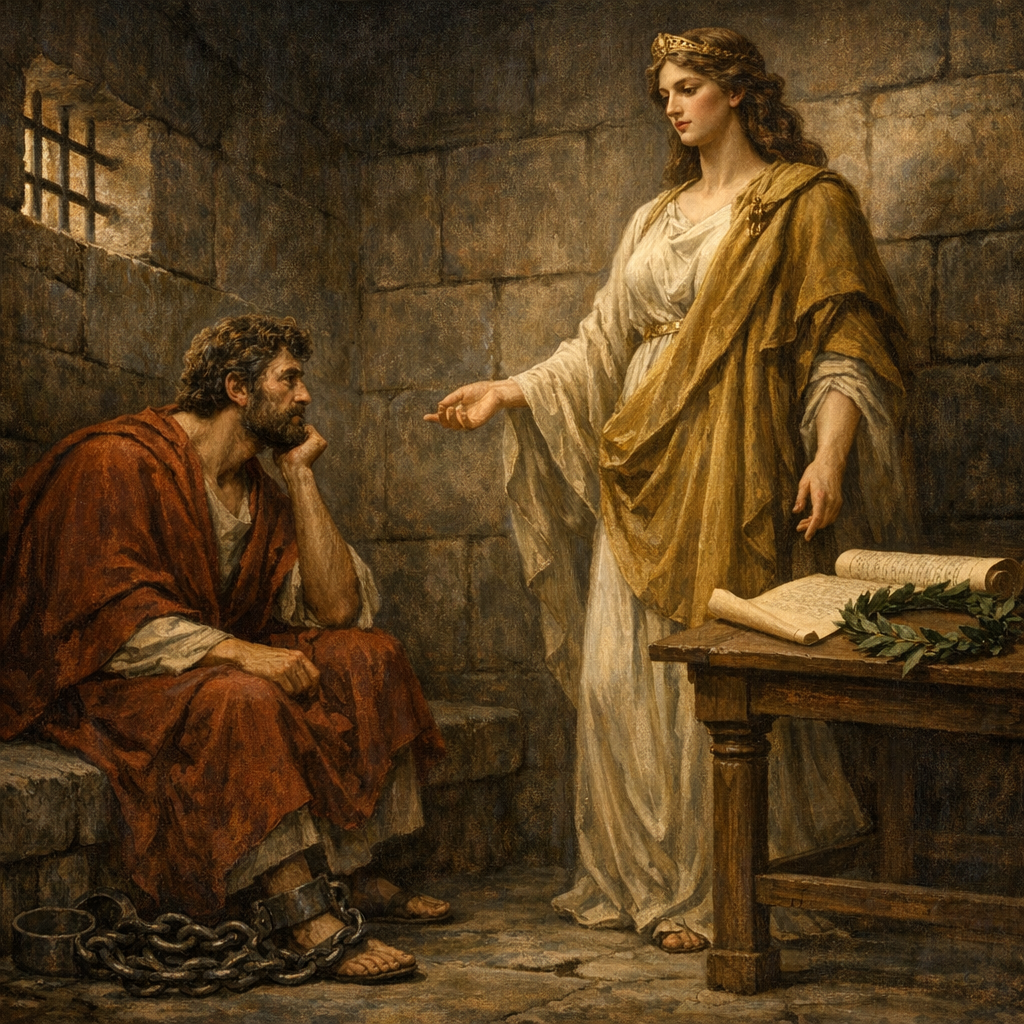
Question: When someone less competent or less honorable is promoted or honored over you, how should a person of pietas respond?
True honor flows from the virtue you bring to a role, not from the role itself. Boethius teaches that virtue is good in itself and is the only thing that survives death. Cultivate the soul first; the rest is secondary.
…if, as rarely happens, places of honour are granted to honest men, what else is delightful in them but the honesty they practise thereby? Wherefore honour comes not to virtue from holding office, but comes to office from virtues there practised. — Boethius, The Consolation of Philosophy
Someone with half the competence and character gets the promotion over you. Another has a platform of thousands, if not millions, just for being obnoxious while you have a hard time finding one person who will listen to your ideas for more than five minutes. A third has gotten rich deliberately gaming the system, selling people what they don’t need, while your product which provides real value flounders.
You don’t have to live long to begin experiencing acute moments of injustice, whether real or imagined. “That’s not fair” is one of the first sentiments a child learns to express. The gulf between what ought to be and what is can sometimes feel vast and insurmountable.
The worst part is that many lack someone in their lives capable of bringing perspective to this perennial problem, someone who is able to reframe how we see things through the lens of our moral reality. For those lacking such a voice in their lives, and even for those who do, reading someone like Boethius can mean the difference between lifelong frustration and peace in the midst of injustice.
In the quote above, Boethius reminds us that it is not the utility of something that should be our first consideration, but its morality. The moral is the foundational layer of reality and the most essential aspect of our humanity. Specifically, he has Lady Philosophy counsel us that it is not the benefits we derive from a given role, job, or position that is most important; what’s most important is the character and virtue we bring to it.
One reason is that virtue is good in and of itself, regardless of its effects (although those are generally beneficial as well). But another reason is, under Boethius’ paradigm, our character, not the perks of positions, is the only thing that survives death. Even reputation fades, but the soul endures forever.
Given this paradigm, it’s not difficult to see why Boethius considers the cultivation of our souls a much better investment than whatever affluence we can accumulate on this earth. The former lasts while the latter fades.
The West has decided in recent decades that the question of what happens after death is best confined to churches and university philosophy departments. But Boethius reminds us the answer to that question affects how we see everything else.
We should treat such a consequential question with the care and attention it deserves.