
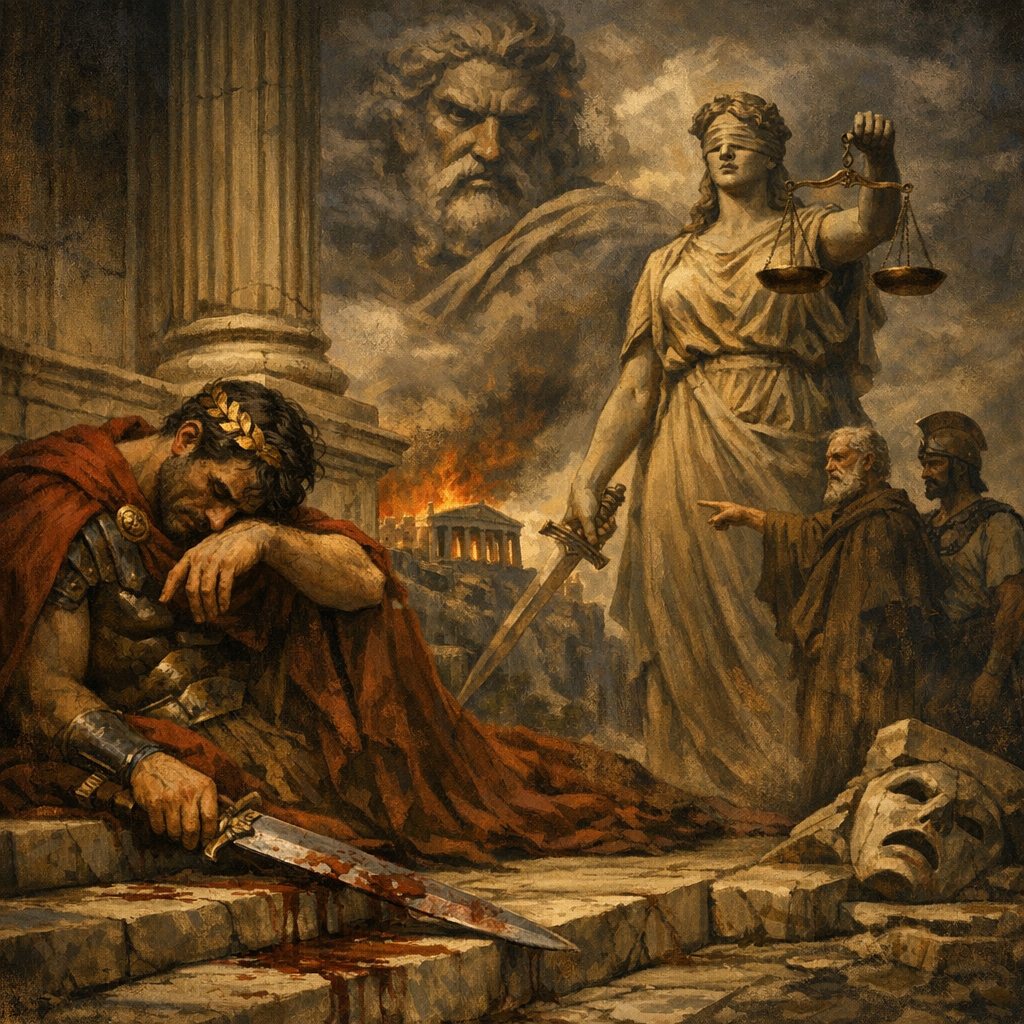
All men make mistakes, but a good man yields when he knows his course is wrong, and repairs the evil. The only crime is pride. — Sophocles, Antigone
These words come from a blind prophet confronting a king in one of the ancient Greek tragedies, where the clash between human law and divine duty leads to ruin. In the story, the king Creon forbids the burial of a fallen enemy to assert his authority, but this defies the unwritten laws of the gods and basic human decency. When his error is pointed out by his people, his family, even the gods through signs, he refuses to back down. His stubbornness destroys his house; his son and wife take their own lives, leaving him broken. Sophocles shows that all men make mistakes, but pride makes them permanent and irredeemable. It is the refusal to correct course that invites catastrophe.
This lesson anchors pietas, the disciplined fusion of moral duty and contentment. Duty requires us to face facts when our actions stray from conscience or Providence, no matter how it stings the ego. Contentment lets us accept our fallibility and make the fix without grudge. Pride breaks this bond. It elevates the self above truth, treating duty as optional and contentment as defeat. The proud man cannot pause; he demands the world reshape itself around his flaws, and in the end, he stands alone amid the wreckage he caused.
The Stoics grasped this plainly. Marcus Aurelius, ruling an empire under constant threat, wrote in his private reflections: “Be content to seem what you really are.” He adjusted his battle plans during endless wars against invaders, heeded his generals’ advice, and bore Rome’s weight without chasing acclaim. His power came from humility: the willingness to amend errors swiftly. Cicero, the Roman statesman, argued in On Duties that pride obscures justice and charged leaders to put moral law before personal pride. For these men, yielding was strength: standing resolute in virtue while adapting to reality.
Today, pride wears everyday masks. It shows in the man who ignores feedback at work, convinced his method is flawless, until projects fail and trust erodes. It lurks in family disputes where admitting wrong feels like losing, driving wedges deeper over time. The digital world feeds it: screens echo our views, notifications stroke our ego, and we mistake curated lives for control. A man might scroll endlessly for approval, resent setbacks as unfair, or cling to bad habits because change admits weakness. The toll is quiet but real; it shows in strained bonds, stalled growth, and a soul restless and unfulfilled.
The correction demands practice, so we must start small. In a disagreement, hear the other side before defending. Revisit a choice when facts shift. Own a fault plainly, without deflection. These forge the habit of repair. Contentment manifests when we release outcomes to Providence, focusing on right action over right appearance. A man who lives this finds steadiness in the midst of chaos and earns trust from those around him.
Pride alone bars redemption and exiles peace. Embrace pietas and reclaim both. Consider where you have resisted correction this week (whether at work, at home, or in your conscience), and resolve to amend it without grudge.