
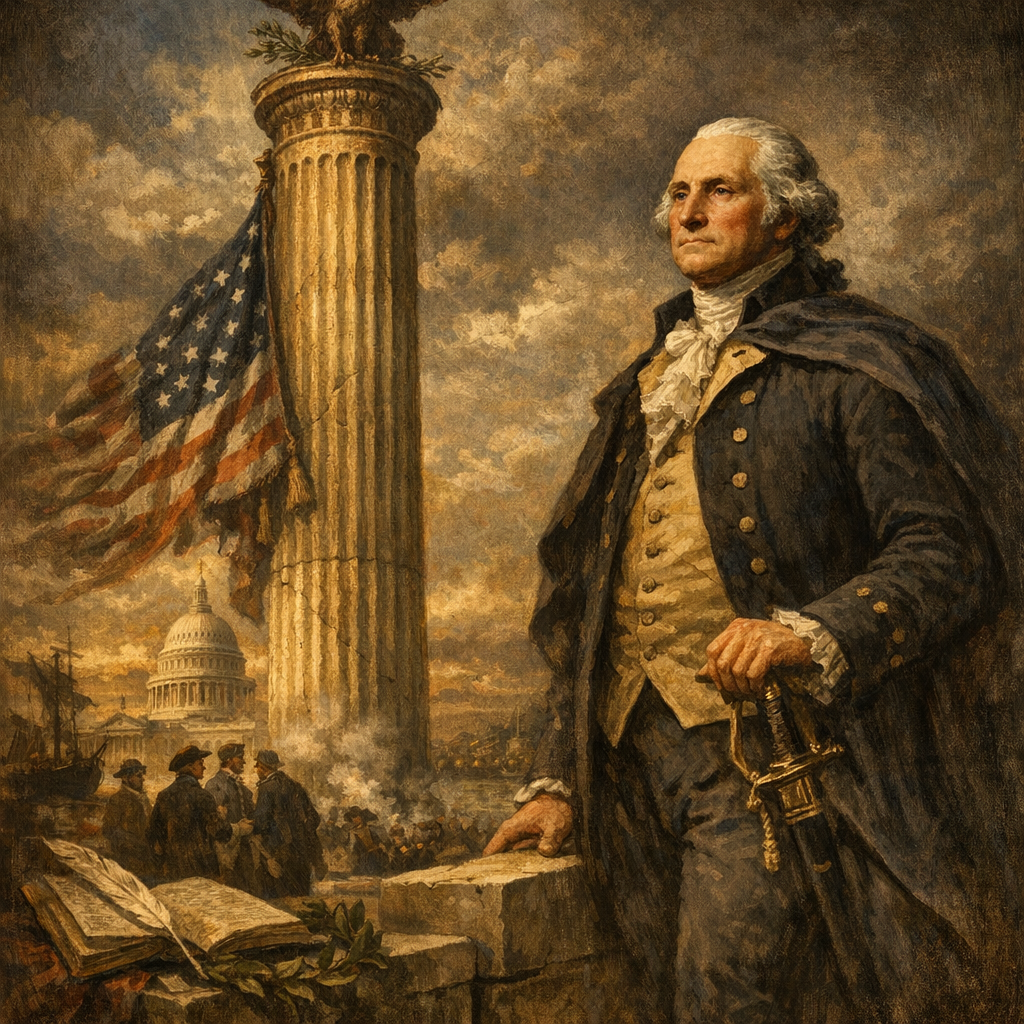
The unity of government which constitutes you one people is also now dear to you. It is justly so; for it is a main pillar in the edifice of your real independence, the support of your tranquility at home, your peace abroad, of your safety, of your prosperity, of that very liberty which you so highly prize. — George Washington, Farewell Address, 19 September 1796
Washington was not a king, nor did he wish to become one. He was a citizen who had twice answered the call of his country and who now, at the close of his public life, spoke with the plain authority of a man who had faithfully discharged his duty. The Farewell Address is not a farewell of sentiment; it is a moral exhortation. Washington saw the forces already gathering that could undo what eight years of war and deliberation had secured, and he named them plainly: sectional jealousy, the spirit of party, foreign intrigue, and the slow erosion of those “indispensable supports” of religion and morality.
The address is a single, sustained argument for pietas at a national scale. Washington did not separate duty from contentment. He knew that a free people could remain free only so long as they accepted the discipline of union and the restraint of virtue. To love liberty without accepting the duties that preserve it is to love an illusion. The man who demands rights while scorning obligations is has no idea what freedom is for.
Washington warned first against the “baneful effects of the spirit of party.” Faction, he wrote, “serves always to distract the public councils and enfeeble the public administration. It agitates the community with ill-founded jealousies and false alarms, kindles the animosity of one part against another.” Two centuries later the warning has lost none of its force. We have multiplied parties, platforms, and identities until the name “American” is often the last we utter. Washington did not forbid disagreement; he demanded that disagreement remain subordinate to the common good. When party becomes the lens through which every question is viewed, the republic itself grows dim.
He warned next against “the insidious wiles of foreign influence.” A nation that allows its domestic factions to be played against one another by external powers has already begun to surrender its independence. Permanent alliances, he counselled, entangle peace and prosperity “in the toils of European ambition, rivalship, interest, humor, or caprice.” The counsel was not isolation; it was self-mastery. A people who cannot govern their own passions will soon be governed by the passions of others.
Yet the deepest warning, and the one most often forgotten, concerns the moral foundation: “Of all the dispositions and habits which lead to political prosperity, religion and morality are indispensable supports.” Washington was not proposing a theocracy. He was stating a fact of human nature observed across every age: a people who sever virtue from liberty will not long keep either. When the sense of religious obligation deserts the oaths that bind courts and legislatures, when private character is no longer the measure of public trust, the machinery of government becomes a hollow shell. Laws multiply, trust collapses, and men look for a strong hand to restore order. Washington had seen that road in Europe; he refused to let his country walk it.
The address is therefore not a relic but a mirror. We read it today and see the same forces already at work in our own divisions and the slow loosening of conscience. The remedy Washington prescribed has not changed: a “cordial, habitual, and immovable attachment” to the Union; a jealous watchfulness over its preservation; and a daily return to the duties of conscience, family, and local community. These are not grand abstractions. They are the small, repeated acts of self-command that, taken together, form the character of a free people.