
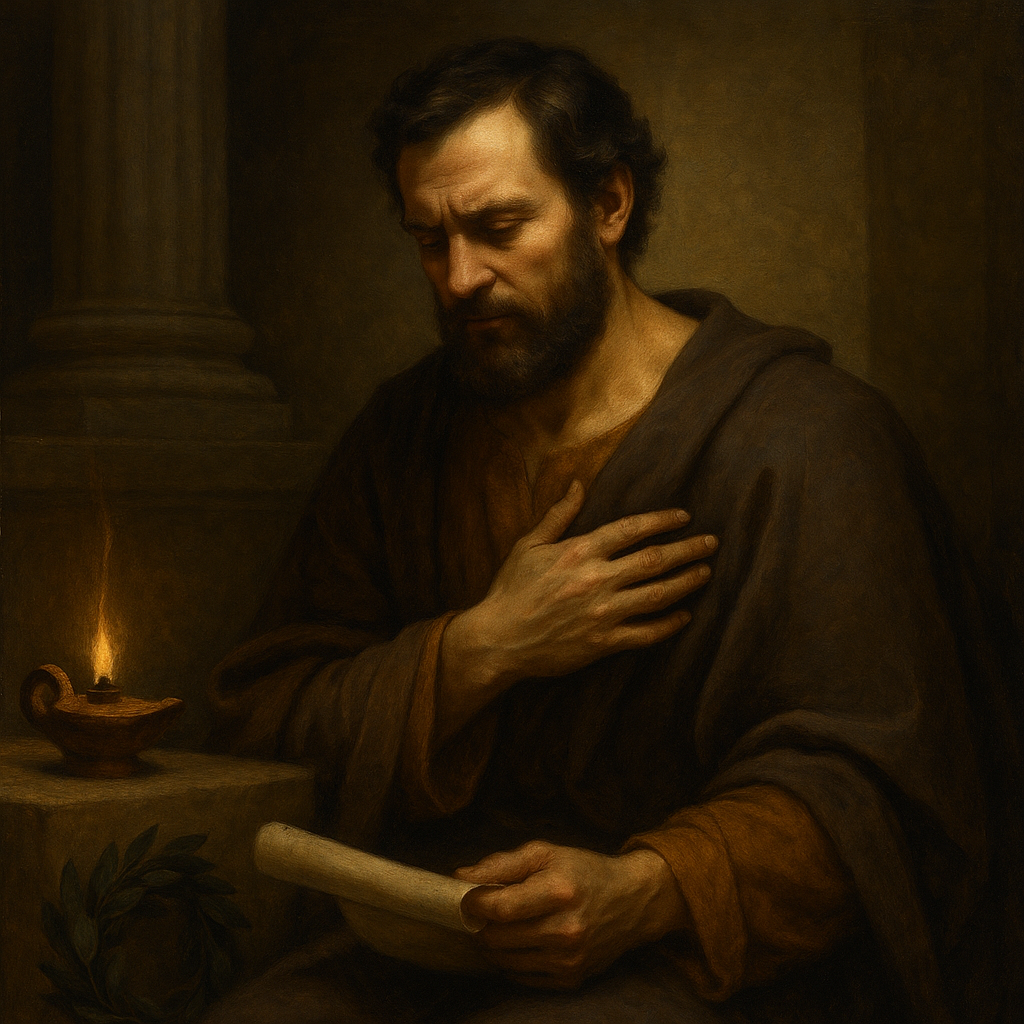
Pietas Quest Question: What is realistic gratitude and why is it a matter of moral duty rather than mere social etiquette?
Direct Answer
Before pietas, gratitude is often superficial or performative, reduced to social etiquette or forced politeness. After pietas, gratitude becomes a realistic assessment of favors received and a response to our moral sense, recognizing that we are bound in duty to esteem the person who bestowed them. This is the highest class of human happiness and the path to meaningful living.
To show real gratitude is to recognize “that we are bound in duty” to respond to our moral sense.
Growing up, I never liked the idea of gratitude. That seems like a very odd thing to dislike, but the reason was fairly simple. I, for some reason, equated the idea of gratitude with being fake. I thought that to be truly grateful, you had to pretend that nothing is wrong, act like the world is all roses and butterflies, and praise people for more than they actually deserve.
This approach, not grounded in reality, is built on lies and therefore unappealing. But it is not true gratitude. True gratitude is a realistic assessment of what people have done to have a positive impact on you, especially when they could have done otherwise. This is hard to determine when you are younger because you take so much for granted. For example, I grew up in a two-parent house with a present mother and father who never failed to put food on the table and clothes on my back, and I wanted for nothing. It is only with the perspective that comes with time, and by seeing how many others grew up not having those things, I realize how truly fortunate I have been. There is nothing fake about this kind of gratitude. It is a fact that others sacrificed for my good, and the gratitude I have for them is grounded in that reality.
John Witherspoon, signer of the American Declaration of Independence, president of the College of New Jersey (later Princeton), and Scottish Common Sense philosopher, describes gratitude in his Lectures on Moral Philosophy as a component of love, which “is founded on esteem, on the real or supposed good qualities of the object” (pg. 48). Love, according to Witherspoon, cannot be fabricated. It is generated by the characteristics of the thing or person that is loved.
For Witherspoon, to be grateful is “to have a lively sense of favors received, and to esteem them for the sake of the person from whom they came” (pg. 48). For him, there are two parts to gratitude: the favor or act itself and the person doing it. In his framing, the favor serves as an opportunity to appreciate the person in and of himself, not just for the favor given. The favor is the catalyst for this recognition.
Witherspoon also points out that “every man who has bestowed signal favors upon another, expects to see evidence of a grateful and sensible mind, and severely condemns every sentiment or action that indicates a contrary disposition” (pg. 50). In other words, while there is no grounds for expecting gratitude in the absence of an act that warrants it, the person who does something for someone else is right to expect gratitude in return. As with the person receiving the favor, the one giving it is not unrealistic in his or her expectations. This reciprocation, however, depends on the recipient possessing a “sensible mind.”
Elsewhere, the Common Sense philosophers (Witherspoon included) describe the moral fabric of reality as something that may be perceived by human beings through what they variously refer to as common sense, conscience, intuition, and, simply, the moral sense. Within that moral framework, when one person does a favor for another, the moral law is triggered and demands satisfaction. Gratitude isn't just a nice or socially acceptable response to favors bestowed. It really is the good and just response given the moral order of the universe we inhabit.
Witherspoon sees gratitude as a human right, but an imperfect one. Unlike perfect rights, such as the right to self-preservation, “Imperfect rights are such as we may demand, and others ought to give us, yet we have no title to compel them” (pg. 55). Since imperfect rights are those “you ought not to use force to obtain in a state of natural liberty, human laws in a well constituted state will not give [them to] you” (pg. 70). In other words, gratitude is an obligation in which the first and final arbiter is the moral law itself. Consequently, it is not enforceable through any man-made law and cannot be coerced, either by the state or individuals.
What, then, is the point of showing gratitude if it is unenforceable and we suffer no loss of life, liberty, or property in refusing to do so? To answer this, we must look to Witherspoon’s understanding of human nature and the three classes of gratification. The first and lowest, although not inherently wrong, is the “gratification of the external senses,” which “affords some pleasure” (pg. 19). The second “are the finer powers of perception,” which include “[p]oetry, painting, music…and the exercise of mental powers in general” (pg. 20).
Gratitude falls into the third class of human gratification. “Superior” to the first two classes, the third “is a sense of moral excellence, and a pleasure arising from doing what is dictated by the moral sense.” Of the three classes, this third one is “the most noble, pure and durable” and consequently “is to be preferred before all other sources of pleasure” (pg. 20). Gratitude, therefore, is not simply a social expedient, and it is far from irrelevant just because it is unenforceable through man-made law. On the contrary, to be grateful is to embrace the highest class of human happiness.
However, even more foundational for Witherspoon than this observation regarding gratification is the fact that the “moral sense implies also a sense of obligation, that such and such things are right and others wrong.” To show real gratitude for real acts of kindness is not just to participate in the noblest, purest, and most durable form of happiness. It is to recognize “that we are bound in duty” to respond to our moral sense (pg. 21). Gratitude, and morality in general, is not just a matter of happiness. It is a matter of meaningfulness. Meaning is found in thinking, doing, and being that which is truly right and good. A grateful society pursues this kind of meaning above all else.
 Join the Pietas Quest